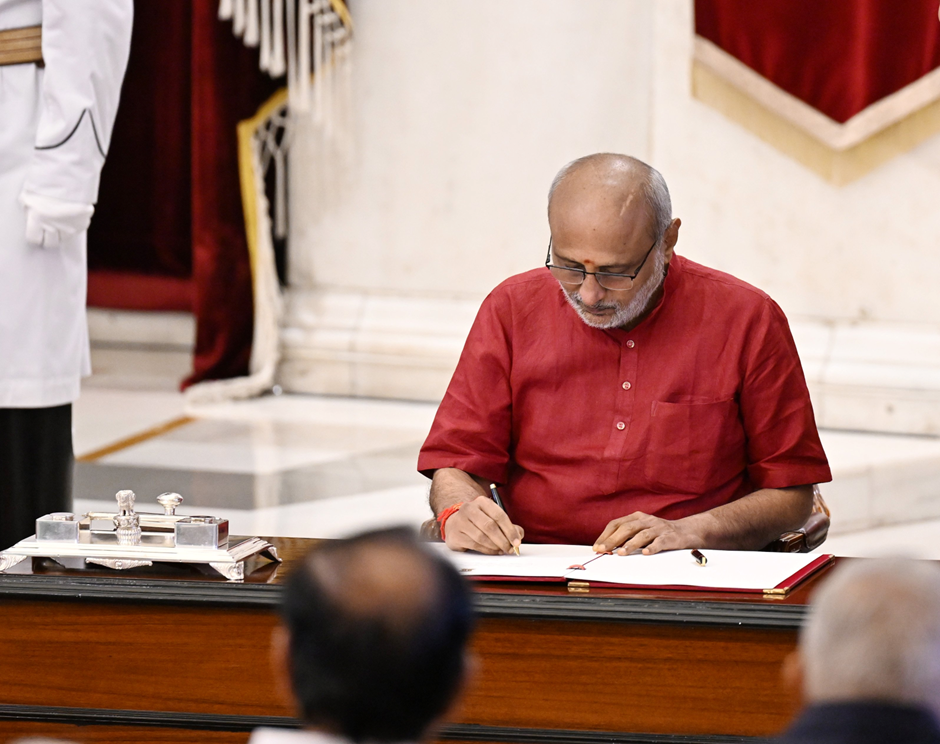
New Delhi, September 12, 2025 — Chandrapuram Ponnusamy Radhakrishnan was formally sworn in today as the 15th Vice-President of India. The oath was administered by President Droupadi Murmu at a ceremony held at Rashtrapati Bhavan at around 10:10 a.m.
Radhakrishnan, aged 67, took the oath in English invoking the name of God, dressed in a red kurta. The ceremony was attended by leading political figures including Prime Minister Narendra Modi, senior Union ministers like Amit Shah, Rajnath Singh, and Nitin Gadkari, BJP President J. P. Nadda, former Vice-Presidents, former President Ram Nath Kovind, and others. Jagdeep Dhankhar, the previous Vice-President who resigned in July, was also present. Opposition leaders Rahul Gandhi and Mallikarjun Kharge were notably absent.
Election and Margin of Victory
The election for Vice-President took place on September 9, 2025, after the resignation of Jagdeep Dhankhar on July 21, on health grounds. Radhakrishnan, the candidate of the ruling National Democratic Alliance (NDA), defeated the opposition’s joint nominee, former Supreme Court Justice B. Sudershan Reddy, by 152 votes. Out of 781 electors, 767 cast their votes; of these, 752 were valid and 15 invalid. Voter turnout was over 98% among MPs.
Background and Political Career
Radhakrishnan was born on May 4, 1957, in Tiruppur, Tamil Nadu. He belongs to the Kongu Vellalar Gounder community. For education, he earned a Bachelor’s degree in Business Administration (BBA). Early in life, he became involved with the Rashtriya Swayamsevak Sangh (RSS), and in 1974 was elected to the state executive committee of the Jan Sangh. After the Jan Sangh evolved into the Bharatiya Janata Party (BJP) in 1980, Radhakrishnan took up multiple organisational and political roles.
He was elected twice to the Lok Sabha from Coimbatore (in 1998 and 1999). During his time as MP he was known for being part of parliamentary committees (Public Sector Undertakings, Finance) and participated in international forums. He also served as State President of BJP in Tamil Nadu in the mid-2000s.
More recently, before becoming Vice-President, Radhakrishnan held gubernatorial posts. He was appointed Governor of Jharkhand in February 2023. He has also held additional charge of the Governorship of Telangana and been the Lieutenant Governor of Puducherry. In July 2024, he was sworn in as Governor of Maharashtra. Between 2016-2020 he chaired the Coir Board under the Ministry of MSME; during that period India’s coir exports reached record levels.
Significance of the Appointment
Radhakrishnan’s elevation to Vice-President carries both constitutional and political significance:
- The Vice-President of India serves as the ex officio Chairman of the Rajya Sabha (Upper House of Parliament), presiding over its sessions.
- His win reflects the BJP’s strategy to deepen its reach in South India, especially in Tamil Nadu, where it has traditionally had limited influence.
- He is seen as having a reputation for congenial relations with political opponents in Tamil Nadu and elsewhere — sometimes dubbed the “Vajpayee of Coimbatore” for his moderate, non-confrontational style.
- His being from an OBC (Other Backward Classes) community is viewed as part of broader considerations of social representation in national politics.
Conclusion
The oath of office today marks the formal assumption of one of India’s highest constitutional positions by a veteran public servant whose career spans over four decades, with roles in party organisation, Lok Sabha representation, governance, and administration. As Vice-President, Radhakrishnan steps into a role that, while largely ceremonial, plays crucial parts during parliamentary sessions, in preserving constitutional integrity, and providing symbolic leadership. His background, affiliations, and political journey suggest that his tenure may emphasise parliamentary decorum, cooperative federalism, and maintaining institutional norms.